import numpy as np
from scipy.optimize import root
import matplotlib.pyplot as plt
from matplotlib import cm

"""
set up the problem parameters
"""

# domain parameters
a = 0
b = 1
c = 0
d = 1

# number of grid points
Nx = 20
Ny = 20

# Value of the constant source term
q = 1

"""
construct the grid
"""

# grid points
x = np.linspace(0, 1, Nx+1)
y = np.linspace(0, 1, Ny+1)
x_int = x[1:Nx]
y_int = y[1:Ny]

# grid spacing in x and y directions
dx = (b - a) / Nx
dy = (d - c) / Ny

# total number of unknowns
dof = (Nx - 1) * (Ny - 1)
print('There are', dof, 'unknowns to solve for')

# mapping from grid indices (i,j) to global indices (k)
k = lambda i,j : i + (Nx - 1) * j

"""
Setting the initial guess of the solution, which is assumed
to be given by u(x,y) = x*y*(1-x)*(1-y).  First we
create this as a 2D array named u_0.  Then we convert
the 2D array into a 1D array named U_0.  Notice how the
mapping function k defined above is used to calculate
the indices of the 1D array using the two local grid
indices i and j
"""

# pre-allocate the 2D array
u_0 = np.zeros((Nx - 1, Ny - 1))

# use a double for loop to create the initial guess as a 2D array

for i in range(Nx - 1):
    for j in range(Ny - 1):
        u_0[i, j] = x_int[i]*y_int[j]*(1-x_int[i])*(1-y_int[j])

# pre-allocate the 1D array
U_0 = np.zeros((Nx - 1) * (Ny - 1))

# use a double for loop to store each u[i,j] in U_k
for i in range(Nx - 1):
    for j in range(Ny - 1):
        U_0[k(i,j)] = u_0[i,j]


"""
Function to pass to SciPy's root.  This function
builds the algebraic system in the form F(U) = 0,
where U is a 1D array that contains the solution
components at all interior grid points.  The code
below is not optimal and improvements can be made.
"""

def dirichlet_problem(U):

    # Pre-allocation of 2D arrays
    u = np.zeros((Nx-1, Ny-1))
    F = np.zeros((Nx-1, Ny-1))

    # Convert the 1D soln array U[k] into a 2D array u[i,j]
    for i in range(0, Nx - 1):
        for j in range(0, Ny - 1):
            u[i,j] = U[k(i,j)]

    # Build the algebraic system as a 2D array F[i,j]
    for i in range(0, Nx - 1):
        for j in range(0, Ny - 1):

            # near x = a boundary
            if i == 0 and 0 < j < Ny - 2:
                F[i,j] = (
                    (u[i+1,j] - 2 * u[i,j] + 0) / dx**2 +
                    (u[i,j+1] - 2 * u[i,j] + u[i,j-1]) / dy**2 +
                    q
                )

            # near x = b boundary
            elif i == Nx - 2 and 0 < j < Ny - 2:
                F[i,j] = (
                    (0 - 2 * u[i,j] + u[i-1,j]) / dx**2 +
                    (u[i,j+1] - 2 * u[i,j] + u[i,j-1]) / dy**2 +
                    q
                )

            # near y = c boundary
            elif j == 0 and 0 < i < Nx - 2:
                F[i,j] = (
                    (u[i+1,j] - 2 * u[i,j] + u[i-1,j]) / dx**2 +
                    (u[i,j+1] - 2 * u[i,j] + 0) / dy**2 +
                    q
                )

            # near y = d boundary
            elif j == Ny - 2 and 0 < i < Nx - 2:
                F[i,j] = (
                    (u[i+1,j] - 2 * u[i,j] + u[i-1,j]) / dx**2 +
                    (0 - 2 * u[i,j] + u[i,j-1]) / dy**2 +
                    q
                )

            # near x = a, y = c corner
            elif i == 0 and j == 0:
                F[i,j] = (
                    (u[i+1,j] - 2 * u[i,j] + 0) / dx**2 +
                    (u[i,j+1] - 2 * u[i,j] + 0) / dy**2 +
                    q
                )

            # near x = a, y = d corner
            elif i == 0 and j == Ny - 2:
                F[i,j] = (
                    (u[i+1,j] - 2 * u[i,j] + 0) / dx**2 +
                    (0 - 2 * u[i,j] + u[i,j-1]) / dy**2 +
                    q
                )

            # near x = b, y = c corner
            elif i == Nx - 2 and j == 0:
                F[i,j] = (
                    (0 - 2 * u[i,j] + u[i-1,j]) / dx**2 +
                    (u[i,j+1] - 2 * u[i,j] + 0) / dy**2 +
                    q
                )

            # near x = b, y = d corner
            elif i == Nx - 2 and j == Ny - 2:
                F[i,j] = (
                    (0 - 2 * u[i,j] + u[i-1,j]) / dx**2 +
                    (0 - 2 * u[i,j] + u[i,j-1]) / dy**2 +
                    q
                )

            # grid points not adjacent to a boundary
            else:
                F[i,j] = (
                    (u[i+1,j] - 2 * u[i,j] + u[i-1,j]) / dx**2 +
                    (u[i,j+1] - 2 * u[i,j] + u[i,j-1]) / dy**2 +
                    q
                )

    # Now the 2D array for F[i,j] needs to be converted into a
    # 1D array of the form F[k]
    F_1d = np.zeros((Nx-1) * (Ny-1))
    for i in range(Nx-1):
        for j in range(Ny-1):
            F_1d[k(i,j)] = F[i,j]


    # return the 1D array
    return F_1d


"""
Solve the algebraic system using SciPy's root function
"""

# Solve
sol = root(dirichlet_problem, U_0)

# Check for convergence
print(f'Did root converge: {sol.success}')
U = sol.x

"""
turn the 1D solution array U into a 2D array u
"""
u = np.zeros((Nx-1, Ny-1))
for i in range(Nx-1):
    for j in range(Ny-1):
        u[i,j] = U[k(i,j)]


"""
now we plot the solution
"""

# turn the 1D arrays for x_int and y_int
# into 2D arrays for plotting
xx, yy, = np.meshgrid(x_int, y_int)

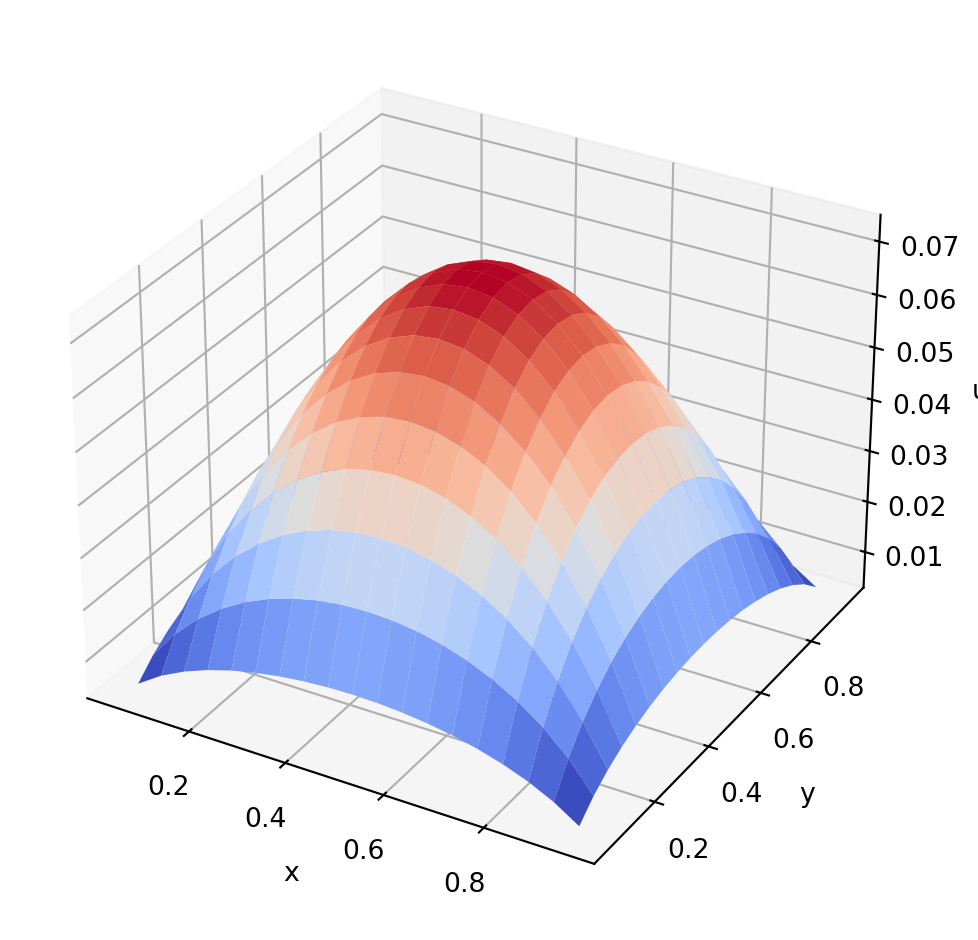
# due to how the global index function k(i,j) is defined
# we need to plot the transpose of u rather than u
fig, ax = plt.subplots(subplot_kw={"projection": "3d"})
ax.plot_surface(xx, yy, u.T, cmap=cm.coolwarm)
ax.set_xlabel("x")
ax.set_ylabel("y")
ax.set_zlabel("u")
fig.tight_layout()

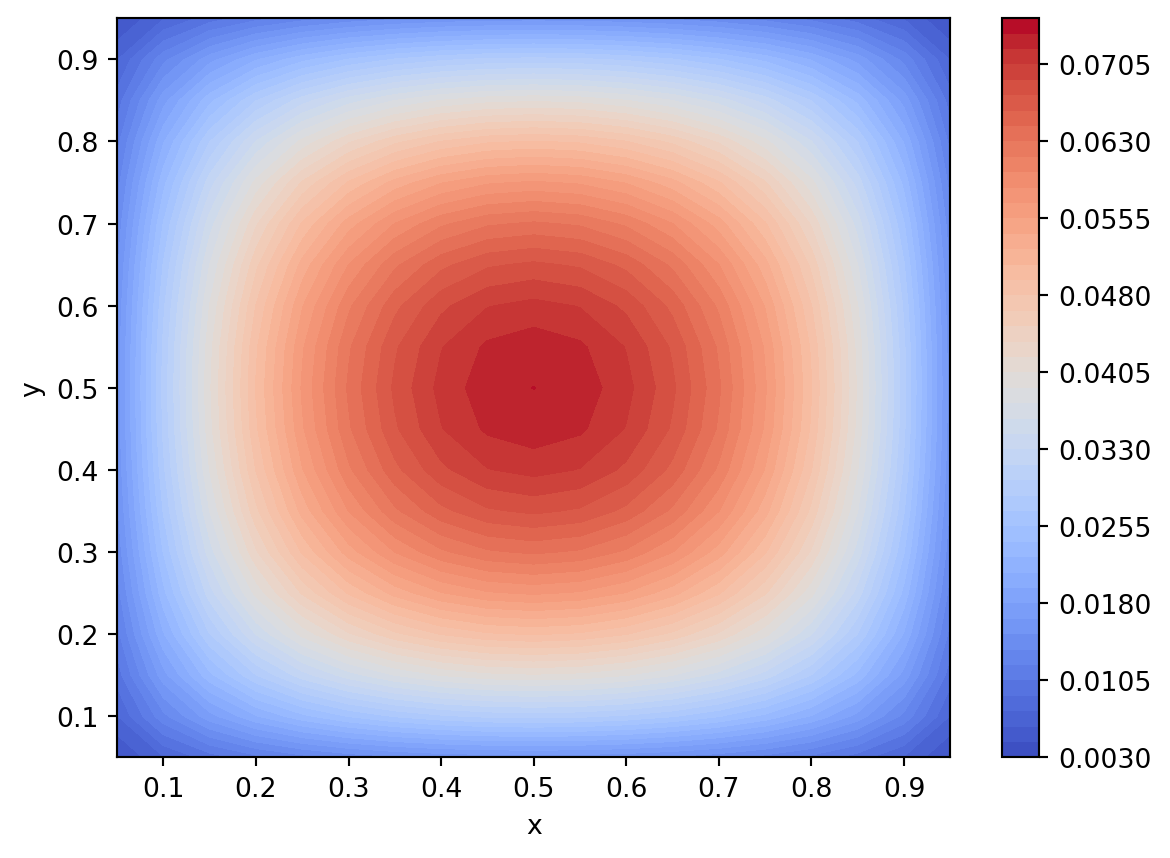
# contour plots are often better to use because
# all the features can be seen
plt.figure()
plt.contourf(xx, yy, u.T, 50, cmap = cm.coolwarm)
plt.xlabel("x")
plt.ylabel("y")
plt.colorbar()

plt.show()